
 407-416-2704
 4.9-star rating on over 750 Google reviews
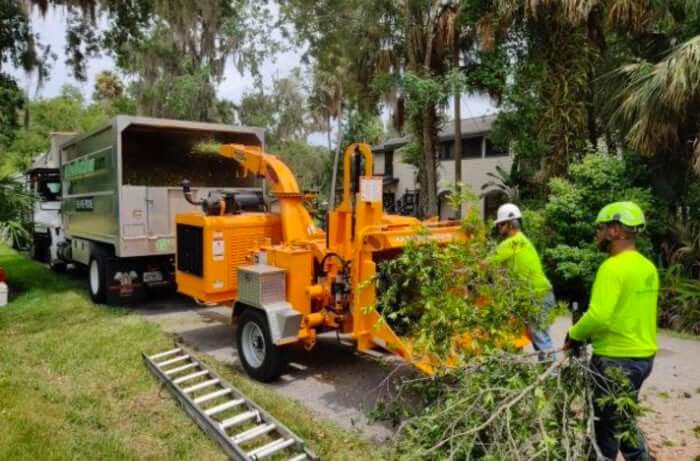
There’s something entirely fulfilling about walking into your Orlando backyard on a clear morning, coffee in hand, looking up at a well-managed tree. Not the scraggly, over-pruned kind that looks like it got into a tussle with a hedge trimmer, but a tree of real shape and presence. Full canopy, clean lines, the type of tree that gives the whole yard a sense of purpose.
Our trees are more than landscaping here in Orlando. Fifty-year-old live oaks shading the same patch of grass. Crepe myrtles that usher in spring with more fanfare than any calendar. Magnolias so grand they basically implore you to slow down and notice them. These trees are part of what makes a Central Florida yard feel like home, and they deserve to be cared for accordingly.
Having worked with trees across this region for years, here’s what every Orlando homeowner needs to know to get tree trimming right.
Timing Is Everything in Central Florida
Orlando’s climate doesn’t follow the seasonal rhythms that most tree care guides are written for. There’s no killing frost to knock everything dormant for months. What we have instead is a wet season, a dry season, a stretch of genuine heat that would send most of the country running by July, and the occasional cold snap that catches everyone off guard.
All of that shapes when and how you should trim.
For most trees in the Orlando area, late winter to early spring is the sweet spot. February and March offer mild temperatures, lower humidity, and the window just before the growing season kicks into gear. Trees trimmed at this time bounce back with energy, pushing new growth in a way that benefits from the pruning rather than fighting against it.
Summer tree trimming is generally fine for routine maintenance, removing dead wood, and clearing storm damage, but avoid heavy structural pruning during the peak heat of July and August. A tree already working hard to stay hydrated doesn’t need the added stress of major cuts.
Fall is the season to be conservative. Stimulating new growth in October or November sends tender shoots into the coolest part of our year, and that new growth is vulnerable to cold snaps that arrive without much warning.
The Tools That Make the Difference
There’s real satisfaction in having the right tool for the job, and tree trimming is no exception.
For smaller branches up to about an inch in diameter, a good pair of bypass pruners will serve you well. Bypass pruners make a clean, scissor-style cut that heals faster than the crushing cut of an anvil pruner. Sharp blades matter more than most people realize. A dull blade tears rather than cuts, and torn wood is an open invitation for disease and pests.
For branches between one and three inches, a folding hand saw or a fixed pruning saw gives you the control and cutting power that bypass pruners can’t match. For anything higher than you can comfortably reach from the ground, a pole saw extends your reach without requiring a ladder.
Speaking of ladders, it’s worth saying plainly: working from an unsecured ladder with a saw in hand is one of the more reliably dangerous things a homeowner can do in a yard. If a branch requires climbing to reach, it may be time to call a professional.
And clean your tools between trees. A quick wipe with rubbing alcohol takes thirty seconds and prevents you from carrying fungal spores or bacterial disease from one tree to the next. It’s a small habit that makes a real difference over time.
How to Actually Trim a Tree Well
The goal of tree trimming is not to make a tree smaller. That’s a common misconception that leads to some of the worst outcomes in residential tree care, including the practice known as topping, where main branches are cut back to stubs. Topped trees are stressed, structurally weakened, and prone to rapid regrowth of weak, poorly attached shoots. Topping is not a solution to an overgrown tree. It’s a problem dressed up as one.
The real goal of trimming is to improve the tree’s structure, remove what is dead or damaged, and help the tree direct its energy where it will do the most good.
Start with the obvious. Dead branches, crossing branches that rub against each other, and any limbs showing signs of disease or pest damage should come out first. These are not judgment calls. They are clear candidates for removal.
From there, look at the overall shape. A well-trimmed tree has a canopy that allows light to filter through evenly, without dense clusters that trap moisture and invite fungal growth. Thinning those clusters, removing weak interior branches, and shaping the outer canopy into a natural form will do more for a tree’s long-term health than almost any other intervention.
Always cut just outside the branch collar, that slightly raised ring of tissue where a branch meets the trunk or a larger limb. The branch collar contains the cells responsible for sealing the wound. Cut into it and you compromise the tree’s ability to heal. Leave too much of a stub and you give decay a foothold.
Orlando’s Trees Each Have Their Quirks
A live oak and a crepe myrtle are not trimmed the same way, and knowing a few species-specific tendencies goes a long way.
Live oaks are among the most structurally complex trees in Central Florida. Their sprawling canopies and heavy horizontal limbs require an understanding of weight distribution before any significant cuts are made. They also develop co-dominant stems more often than most species, meaning two main trunks of roughly equal size growing from the same point. Those junctions are inherently weaker than a single trunk, and a storm can split even a healthy-looking co-dominant oak if the structure hasn’t been managed over time.
Crepe myrtles are beautiful trees that are routinely mistreated across Orlando. Crepe murder, as it’s known among arborists, refers to the annual practice of cutting crepe myrtles back to stubs at the top. It produces knobby, unnatural growth, weakens the tree’s structure, and is entirely unnecessary. A crepe myrtle shaped properly from a young age rarely needs more than light maintenance pruning.
Magnolias drop leaves year-round and can look untidy even when perfectly healthy. Resist the urge to over-prune. Magnolias have a natural form worth preserving, and heavy pruning disrupts it significantly.
When to Call a Professional
There’s genuine satisfaction in maintaining your own trees, and for many routine tasks a homeowner with the right tools and some patience can do excellent work. But some situations call for professional help, not just as a convenience, but as the responsible choice.
Any branch hanging over your roof, a vehicle, or a power line warrants a professional assessment before it comes down. A branch doesn’t have to be dead to be dangerous, and the consequences of a removal gone wrong in those locations are serious.
Large structural cuts on mature trees, anything involving significant weight at height, and any work near utility lines should be left to a certified arborist. The International Society of Arboriculture maintains a searchable directory for finding qualified professionals in the Orlando area.
A good arborist doesn’t just remove what you point at. They look at the whole tree, assess its structure and health, and help you make decisions that serve the tree and the property well over the long term. That perspective is worth a great deal, especially with a tree that has taken decades to become what it is.
A Tree Worth Tending
Every well-kept tree in an Orlando yard represents a quiet kind of commitment. The decision, made at some point, to pay attention. To prune with care rather than convenience. To understand something about how a tree actually works before taking a saw to it.
That commitment pays off in ways that are easy to see and some that are not. A properly maintained tree is safer, healthier, and more beautiful than one that has been neglected or mistreated. It adds genuine value to a property. And on a warm Central Florida evening, with the light coming through a canopy shaped over years of attentive care, it’s simply a pleasure to stand beneath.
Take care of your trees. They have a way of returning the favor.
If you are looking for professional tree trimming services in the Orlando area, keep Tree Work Now in mind. Learn more at treeworknow.com.
 Please call