
 407-416-2704
 4.9-star rating on over 750 Google reviews
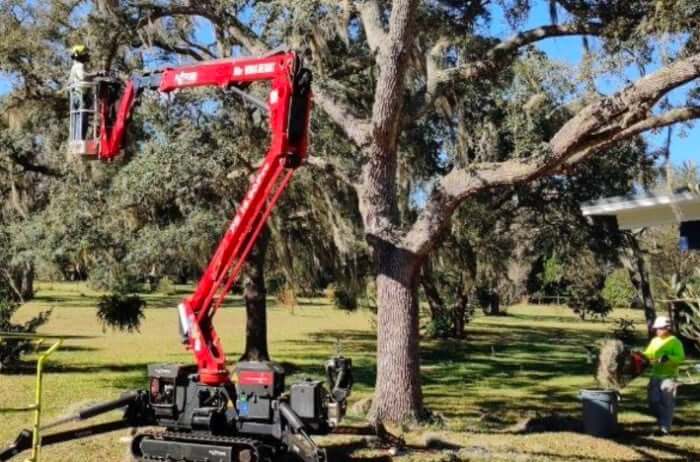
Central Florida Spring has a way of making everything look healthy. The rains return, the canopies fill in, and that tree out back—now a little worse for winter wear—is suddenly sporting a full head of leaves again. All good, right?
Maybe. Maybe not.
Here’s why some tree decline is so tricky in a subtropical climate such as Orlando’s: trees can be actively dying for years but still make new leaves. A tree that is 60 percent hollow can still send its green leaves in April. Ganoderma rot must not destroy the root system, which can still take enough water to appear passable through the wet season. The outside looks fine. The inside is falling apart.
And then hurricane season arrives.
That’s the pattern certified arborists see time and time again across Central Florida—trees that seemed perfectly healthy until, suddenly, they weren’t. The failure looks sudden. But the warning signs? Those were there for months. Sometimes years. The catch is knowing where to look.
April, with its flush of new growth, is actually one of the richest months for spotting these signs—because the contrast between a genuinely healthy tree and one that’s struggling becomes easiest to read when everything else on the property is thriving. So let’s go through the seven signs that most homeowners completely overlook.
1. The Canopy Is Thinner Than It Used to Be—Even With New Leaves
This is the subtle one, the one that hides in plain sight because it happens gradually. A healthy tree’s canopy should be dense enough that you can’t easily see the sky through the interior branches when it’s fully leafed out. If light is filtering through areas that used to be solid canopy—especially in the upper crown—something is wrong.
Arborists call this crown dieback, and it’s one of the earliest visible indicators of root disease, vascular dysfunction, or chronic stress. The tree is essentially triaging itself, abandoning the branch tips and upper canopy that are farthest from the root system because it can no longer supply them with water and nutrients. Think of it like a city shutting off streetlights in the outer neighborhoods during a power shortage—the core still functions, but the extremities go dark.
In Orlando, crown dieback is especially common in aging laurel oaks and water oaks that are entering their decline phase, and in queen palms affected by lethal bronzing disease. If you’re noticing more sky through the canopy this spring than last, that’s not normal thinning. That’s a tree asking for help.
2. Mushrooms at the Base—The Sign Most People Shrug Off
Picture this: a cluster of mushrooms sprouting at the base of a tree, maybe fanning out from the root flare after a few days of rain. Looks kind of natural, right? Almost charming in a forest-floor sort of way.
It is absolutely not charming. It’s one of the most serious warning signs a tree can display.
Mushrooms and shelf-like fungal brackets (called conks) growing at or near the base of a tree are the fruiting bodies of wood-decay fungi that are actively consuming the tree’s structural wood from the inside. By the time these fruiting bodies appear on the outside, the internal decay is often extensive—sometimes shockingly so. The University of Florida’s School of Forest, Fisheries, and Geomatics Sciences has documented cases where trees with visible conks had lost 70–80% of their internal wood structure while still standing and leafed out.
In Central Florida, the most common and most dangerous culprit is ganoderma (Ganoderma zonatum on palms, Ganoderma sessile on hardwoods). Ganoderma causes a white butt rot that destroys the structural integrity of the lower trunk and root plate—exactly the zone that keeps the tree standing. There’s no treatment. Once a ganoderma conk appears, the tree is in irreversible decline and should be evaluated for removal, especially if it’s within striking distance of a structure, car, or foot traffic area.
Other fungi to watch for: chicken of the woods (Laetiporus sulphureus)—bright orange shelves, usually higher on the trunk—and artist’s conk (Ganoderma applanatum), which presents as a hard, woody shelf often mistaken for part of the tree itself.
3. Bark That’s Falling Off in Chunks
Some bark shedding is normal. Sycamores shed bark like it’s a fashion choice. Crape myrtles peel beautifully. That’s just what they do.
But when large sections of bark are separating from the trunk on species that don’t naturally shed—oaks, maples, elms, camphor trees—that’s a different story. Bark is a tree’s protective layer, analogous to skin. When it detaches from the underlying wood, it often means the cambium layer (the thin band of living tissue just beneath the bark) has died in that area. The causes vary: lightning strikes, mechanical damage from lawn equipment, severe freeze injury, or canker diseases caused by fungal pathogens.
Run a hand along the exposed wood underneath. If it’s dry, crumbly, or shows signs of insect boring (small holes, sawdust-like frass), the damage extends beyond the bark. If the bark loss wraps more than a third of the way around the trunk’s circumference, the tree’s ability to transport water and nutrients is severely compromised. Arborists sometimes refer to this as girdling—the tree equivalent of cutting off its own circulatory system.
4. A Lean That Wasn’t There Before
Let’s be clear about something: many trees lean naturally. A live oak that grew toward available sunlight over forty years isn’t suddenly going to stand up straight. Natural lean—where the tree grew into that position and its root system compensated accordingly—is generally stable.
A new lean is a different animal entirely.
If a tree that was previously upright has started tilting, even slightly, that’s a sign of root plate failure. Something underground has shifted. Maybe saturated soil from a heavy rainy season loosened the root grip. Maybe root rot weakened the structural roots on one side. Maybe construction or trenching nearby severed critical anchoring roots. Whatever the cause, a progressive lean means the tree’s stability is actively deteriorating.
Look at the base. Is the soil heaved or cracked on the side opposite the lean? Are roots visibly pulling out of the ground? Is there a gap between the root flare and the soil? Any of these signs accompanying a lean should be treated as urgent—particularly with hurricane season approaching. According to research published through the International Society of Arboriculture, trees with progressive lean and visible root plate movement are among the highest-risk failure categories during high-wind events.
5. Cracks in Major Branch Unions
Where a major limb meets the trunk is one of the most structurally critical zones on any tree. A strong branch union has a visible ridge of bark where the branch and trunk tissues grow into and reinforce each other. A weak union—what arborists call included bark—is the opposite: bark gets trapped in the crotch between the branch and trunk, preventing the tissues from fusing. Instead of interlocking, the branch and trunk are essentially just pressed together, held by friction and habit.
Included bark unions are common in laurel oaks, camphor trees, and Bradford pears (thankfully becoming less common in Orlando landscapes). They’re also common wherever a tree develops co-dominant stems—two main trunks of roughly equal size forking from the same point.
Now, here’s the escalation: when a crack appears at an included bark union, it means the failure process has already begun. The branch is actively separating from the trunk. It may take months or years to fully fail, or it may let go in the next thunderstorm. But the crack is the tree telling you, in the clearest possible language, that this branch union is not going to hold indefinitely.
These cracks are easiest to spot in spring when rain and wind have cleaned bark surfaces and the tree is fully loaded with new foliage weight. Walk the property. Look up. If a major branch union shows a visible crack or a dark seam of separated bark... that’s not something to monitor casually.
6. Leaves That Are the Wrong Size, Color, or Timing
Spring is when foliage tells the truth.
A healthy tree should produce leaves that are consistent in size and color throughout the canopy. When something’s wrong, the foliage signals it—but in ways that are easy to overlook if you’re not specifically watching.
Undersized leaves—noticeably smaller than normal for the species—often indicate root stress or vascular disease. The tree simply can’t supply enough water and nutrients to produce full-sized foliage. It’s doing its best with a compromised plumbing system.
Yellowing leaves in spring (chlorosis) can signal nutrient deficiency, root rot, or soil compaction. In Central Florida’s alkaline soils, manganese deficiency is particularly common in queen palms and shows up as yellowing of the newest fronds. But widespread chlorosis on a hardwood tree—especially if it’s concentrated on one side of the canopy—points to something deeper. Root damage, often.
Delayed leaf-out is another red flag. If every tree of the same species on the street has leafed out and one is still mostly bare... that’s not a late bloomer. That’s a struggling tree. The UF IFAS Extension’s plant diagnostic resources are a solid starting point for identifying species-specific foliage symptoms, and many county Extension offices offer free or low-cost sample analysis.
7. Carpenter Ants, Boring Beetles, and the Bugs That Follow Weakness
There’s a common misconception that insects cause trees to decline. In most cases, it’s the other way around. A healthy, vigorous tree has robust chemical defenses—resins, tannins, phenolic compounds—that repel most wood- boring insects. When those defenses weaken due to drought stress, root damage, disease, or old age, the tree becomes vulnerable. The bugs arrive after the decline has already begun. They’re opportunists, not initiators.
That’s an important distinction, because it means the presence of wood- boring insects is itself a diagnostic sign. Carpenter ants tunneling through a trunk aren’t eating the wood (they excavate it for nesting), but they’re only able to do so because the wood is already softened by decay. Bark beetles and ambrosia beetles leaving tiny pinholes with protruding sawdust “toothpicks” are targeting a tree whose defenses have dropped below the threshold. And termites—particularly the Formosan subterranean termite, which is well-established in the Orlando area—can devastate the interior of a tree that’s already compromised.
If there’s active insect boring in a tree near the house, the concern is twofold: the tree’s structural integrity is compromised (increasing failure risk), and the pest population may migrate to the home itself. That second concern is especially relevant for termites, which will happily follow dead roots from a stump right into a foundation. Yet another reason old stumps should be ground rather than left to rot.
Spring Is the Season to Look—Really Look
Here’s the encouraging part of all this: most of these warning signs are visible to anyone who knows where to look. It doesn’t require a degree in forestry or specialized equipment. It requires a walk around the property in April, with eyes open and some basic knowledge of what healthy versus unhealthy actually looks like.
Thin canopy. Mushrooms at the base. Bark sloughing off. A new lean. Cracked branch unions. Off-color foliage. Bug activity in the wood.
Any one of these warrants a closer look. Two or more on the same tree? That’s a tree that needs professional evaluation before hurricane season arrives in June. The window between now and then is exactly the right time to get ahead of it—while there’s still time to schedule a removal or corrective pruning without the urgency (and inflated pricing) that storm season brings.
Trees are resilient. They’re also silent. They don’t announce their decline the way a roof leak or a failing air conditioner does. They just... quietly stop being the sturdy, reliable things everyone assumed they’d always be. And by the time the silence breaks—usually during a storm—the options have narrowed considerably.
Better to listen now, while there’s still time to act.
If you’re looking for a professional tree assessment or removal service in the Orlando area, keep Tree Work Now in mind. Their expert crews have been serving Central Florida homeowners with safe, reliable tree care for years—known for a rigorous crew selection process and a commitment to treating every property like their own. Learn more at treeworknow.com.
 Please call